
Established consumer brands
They have a market position and are reaching new audiences, upgrading products or reshaping perception.
Turn existing awareness into reasons to choose them in important purchase situations.We observe how AI describes brands, compares products and explains choices in the questions that matter to a business. We connect those findings with verified facts and client goals, then turn perception gaps into content and communications work.
Audiences, situations, product conditions and reasons to choose
Business importance, suitability and information gaps
Content, website, media, PR and continued review
Especially established companies reaching new audiences or upgrading products.
They have a market position and are reaching new audiences, upgrading products or reshaping perception.
Turn existing awareness into reasons to choose them in important purchase situations.International brands entering China, or Chinese companies reaching overseas audiences, need market-specific content.
Reorganize information around local products, audience questions, language and buying paths.They have reputation and communications systems but need to see how AI interprets public information.
Align leadership, marketing, product and IR/PR around important communication tasks.They need ongoing observation, an independent diagnosis or help executing an existing analysis.
Tools, diagnosis and execution can be purchased separately or together.We begin with business discussions and research to identify priority audiences, situations and information goals together. Marketing often leads; complex projects can also involve leadership, product and IR/PR teams.
Six areas of work can be combined around the client's actual gaps. Scope and responsibilities are agreed in the project plan.
Observe mentions, reasons for recommendation, limitations and visible sources for agreed questions, platforms and times.
Assess opportunities, risks and information gaps across audiences, decision stages, perceptions, competition and platform sources.
Build articles and buying guidance from verified facts, localized in Chinese, English and other project languages as needed.
Clarify brand, product, service, conditions and FAQs on the website, with relevant enquiry paths.
Plan media and communications around perception gaps while aligning public facts, conditions and internal teams.
Review answer changes across comparable questions, platforms and times, then adjust priorities.
knowfield.ai, diagnosis and execution can each be purchased separately. Monitoring and agreed analysis may be packaged together; in-depth human analysis is priced separately. Articles, website updates, media and ongoing work have their own execution packages.
Clients can receive all answer data and screenshots for their project. Reports, answers and screenshots are delivered by email; platform entry points, analysis depth, responsibilities and milestones are set out in the proposal.
Low mention rates do not automatically deserve priority. Check business importance, product fit and information gaps first. Publishing, citations, recommendations and business outcomes are observed separately; mention changes are not converted into revenue or ROI.
Start with the business context, then turn AI-answer findings into grounded decisions and practical work.
You do not need a complete AI communication plan to begin. Research and discussion help us agree where investment can be useful.
Understand strategy, priority products, audiences and markets.
Observe how AI describes the brand, compares products and makes recommendations.
Prioritize business relevance, product fit and perception gaps.
Deliver agreed work across content, websites, media and PR.
Observe change on comparable terms and adjust the next priorities.
Knowledge, decisions, creation and observation work together, guided by a specialist team.
Organizes product information, factual evidence and versions to address scattered brand facts.
Build a reliable knowledge baseAnalyzes intent, competitive differences and content priorities to clarify where to focus.
Focus decisions on business prioritiesCreates and localizes content from verified brand facts for the relevant market and channel.
Fit value to real situationsObserves mentions, recommendations, citations and descriptive accuracy as AI answers change.
Turn observation into the next decisionClients can use Guchi Observation to view product monitoring. Reports, answers and screenshots for each project are delivered by email; platforms, sampling frequency and data scope are agreed in the proposal.
See how brands are described, compared and recommended on platforms relevant to each market.

Observe brand appearances, consumption contexts and reasons for choosing in everyday answers.

Read brand comparisons and verify the basis and conditions of recommendations.

Observe brand perception, product descriptions and changing answers.

Record mentions, answer content and sources available on the platform.

Check whether brand and product information fits specific needs.

Focus on comparisons, scenario fit and stated conditions.

Observe descriptions and recommendation reasons in target-market questions.

Observe brand and sources at the Google AI entry point agreed for the project.

Observe Gemini answers and localized expression separately.

Check recommendations, visible citations and their context.

Observe how brand, products and services appear in target questions.
Entry points, versions, regions, sampling frequency and features are defined in each proposal. Google AI and Gemini are observed separately. Platform logos identify scope and do not imply official partnership or certification.
Languages and markets: Chinese, English and other project languages. Content is localized around local brand names, available products, service conditions and purchase journeys.
These areas can be combined for a project; platforms, sampling and report depth are set out in the proposal.
| Client question | Main work | Deliverable |
|---|---|---|
| Which buying discussions matter? | Discuss brand strategy, priority products, audiences, markets and competitors to set the observation scope. | Question and scope definition; answer records. |
| Where are the perception gaps? | Review answers by audience, decision stage, product conditions and competition, then verify key facts. | Key gaps, business priorities and supporting rationale. |
| What should happen next? | Use actual product fit and business importance to agree content and communications priorities. | Recommendations and optional scope for the next phase. |
Your brand and website, priority products and conditions, business questions, target audiences and markets, known competitors, public materials and a point of contact. Goals and materials can be refined during discussion.
Reports are organized around specific business questions. Each important finding should explain what was observed, why it matters and what can be done next.
Clients can receive all answer data and screenshots for their project. Reports, answers and screenshots are delivered by email.
Discuss a diagnostic scopeReport milestones are agreed in the proposal. The report sheet is a structural illustration.Define audiences, scenarios, platforms and scope.
Review answer text, timestamps and screenshots.
Identify missing information and differences in reasons or product conditions.
Set priorities using business importance, facts and product fit.
Specify content, communications and next steps.
These anonymized excerpts from one project show the path from metric definitions to question gaps and competitor comparisons.
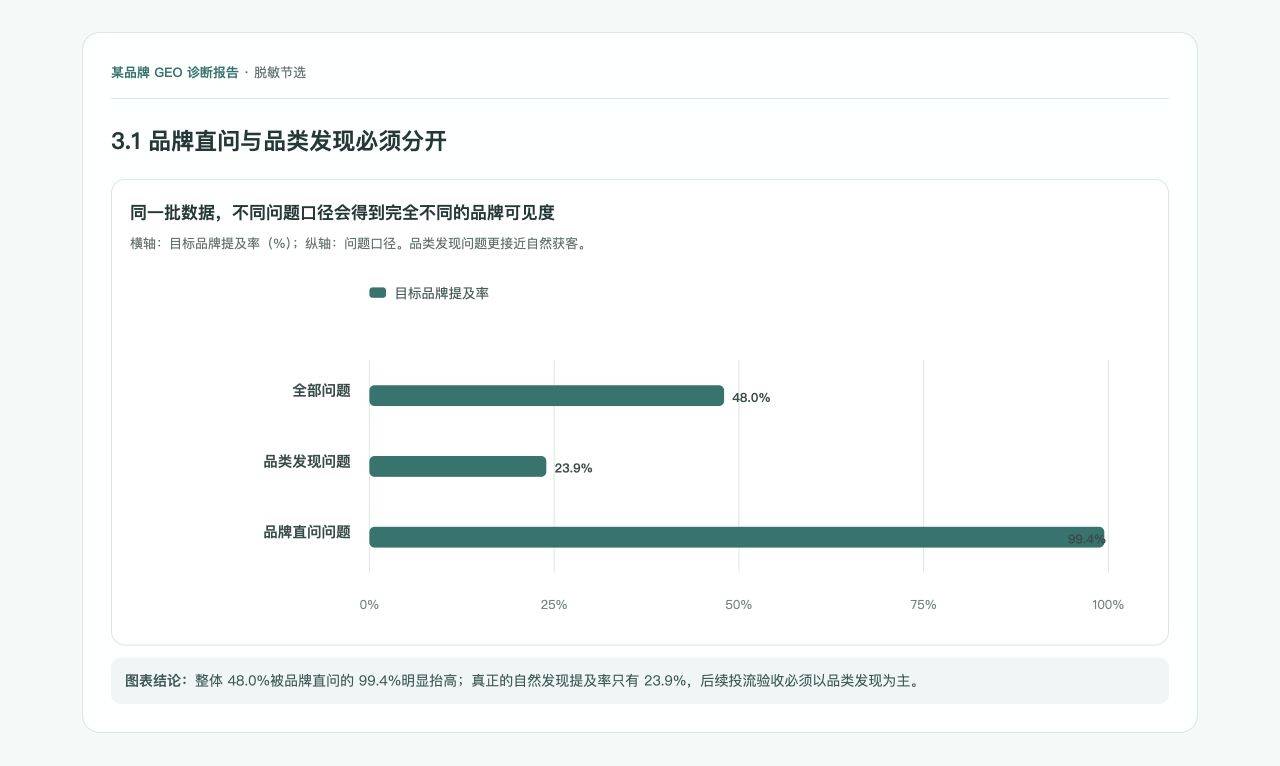
Separate direct brand questions from category discovery questions to see what the overall figure hides.
Enlarge report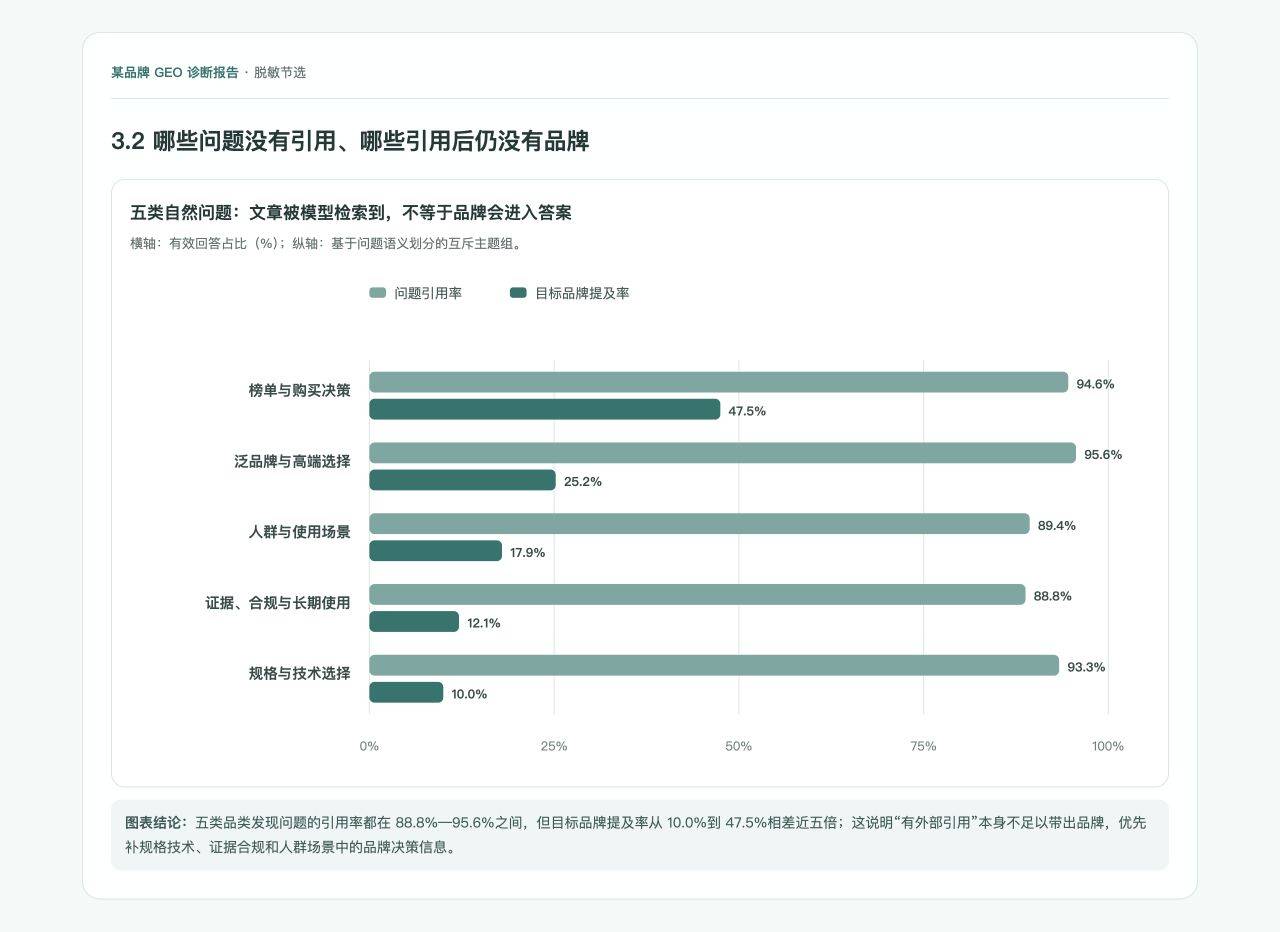
Compare citation and brand mention rates across questions to identify missing information.
Enlarge report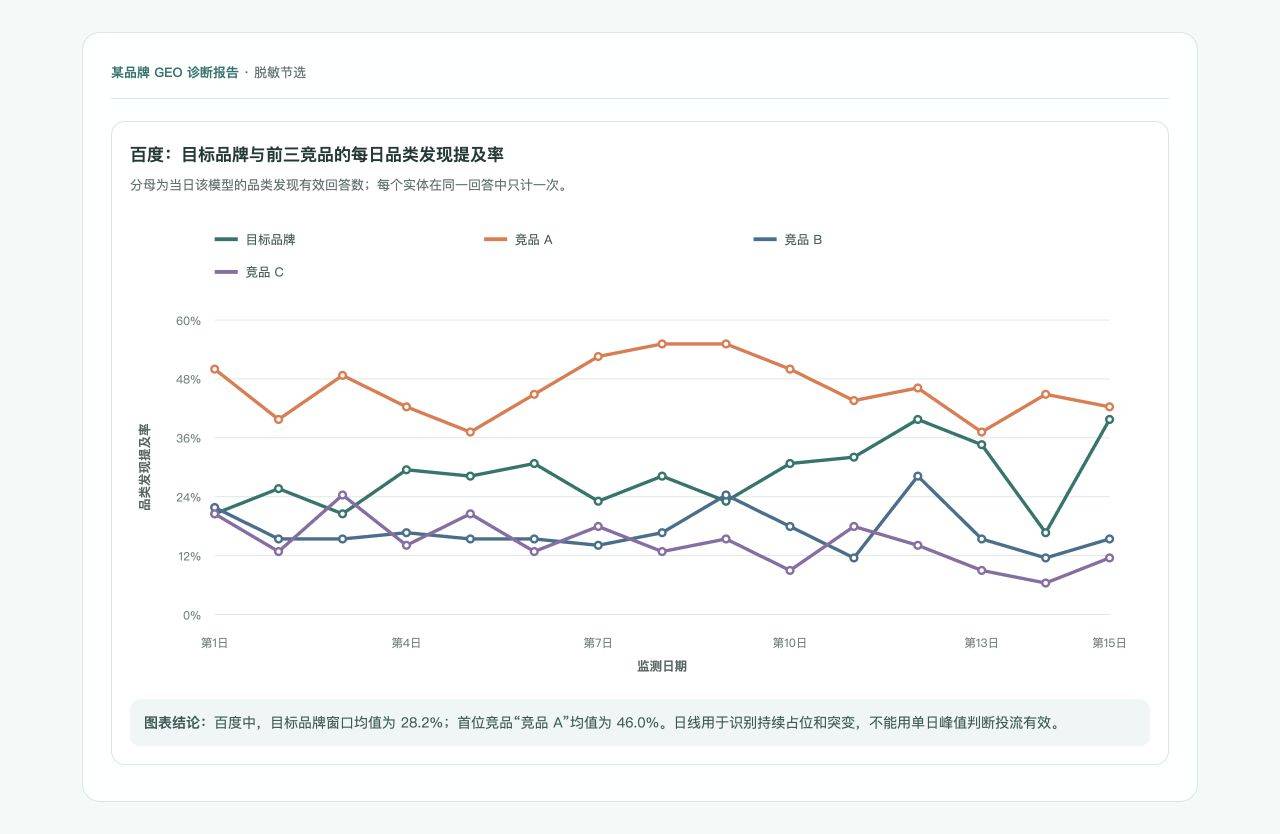
Look across days on a platform to separate persistent gaps from one-day swings.
Enlarge reportFor teams with an unclear goal, or data that still needs business interpretation. We identify priorities through discussion and research.
Discuss the scopeCombine monitoring, analysis, content, website, media, PR and review as needed, with each responsibility defined.
Discuss the scopeTeams with existing expertise can select a tool, diagnosis or execution separately. Scope follows the actual need.
Discuss the scopeFirst check whether your existing work covers how AI ultimately describes, compares and recommends your brand. GEO observes this layer of brand perception; website and search foundations still need maintenance.
Yes. We start with business discussions and research, combining brand strategy, product conditions and target audiences to agree which questions are worth observing and improving.
Yes. Tools, diagnosis and execution can be purchased separately or together. Scope and fees are specified in the proposal.
Guchi Knowledge organizes brand facts, Guchi Strategy sets decision priorities, Guchi Creation supports content and localization, and Guchi Observation tracks brand perception. Reports, answers and screenshots are delivered by email.
Share your needs so we can discuss the scope, demonstrate the product, and provide a quote and initial recommendations. Questions, platforms, sampling and analytical depth are agreed for each project.
Within comparable questions, platforms and time periods, we observe mentions, recommendation reasons, citations and descriptive accuracy. Publication, adoption and business outcomes are evaluated separately. We do not promise fixed rankings, guaranteed citations or sales.
Start with scope, professional judgment and verifiable evidence.
Start with target markets, brand facts and localized content.
Start with questions, facts and content structure.
Share your needs so we can discuss the diagnostic scope, demonstrate the product, and provide a quote and initial recommendations.
An incomplete brief is welcome. We can identify useful questions together.
info@yamaguchitech.cn (+86) 755 8696 7625